- #1401+ QS Global World Ranking
- PrivateStatus
- Very HighResearch Output
- 10,024Total Students
- 470Faculty
- 843Int'l Students
QS Global World Ranking
The University’s position in the current QS World University Rankings.
Status
Whether the University is funded by the government of that country or state, or funded by private donations.
Research Output
The research intensity of the University, based on the number of papers output relative to the University’s size.
Total Students
The number of full time equivalent students enrolled at the University.
Faculty
The number of full time equivalent teaching staff employed by the University.
Int'l Students
The number of full time equivalent international students enrolled at the University.
Shibaura Institute of Technology
About
Read more
Read less
SIT’s predecessor school was founded by Shiro Arimoto in 1927. Since those early days, SIT has remained committed to a practical approach in educating and nurturing engineers. Its founding philosophy is firmly rooted in this legacy. Shiro Arimoto advocated “education in which the various aspects of modern culture are incorporated in the curriculum to help students learn the significance of contributing actively to society.” SIT’s practical approach to education has enabled it to nurture engineers with the practical knowledge and skills necessary to support a technology-oriented country. This, together with its ability to produce outstanding engineers possessed of both a strong sense of ethics and comprehensive knowledge, has underpinned SIT’s long-term contribution to progress and development in society at large. Higher education in Japan is facing an important challenge; Japanese universities need to reform their structures and educational systems to meet global standards. The rapid globalization since 1980s has forced restructuralization of universities throughout the world, due to increasing cross-border movement of students. As a result, prestigious universities in the United States attracted students from Europe and other countries. European countries were not happy with this and ministers of education in European countries gathered in Bologna in 1999 and issued so-called Bologna declaration, which initiated a series of reforms needed to make European Higher Education more competitive and more attractive for Europeans and for students and scholars from other continents.
About
SIT’s predecessor school was founded by Shiro Arimoto in 1927. Since those early days, SIT has remained committed to a practical approach in educating and nurturing engineers. Its founding philosophy is firmly rooted in this legacy. Shiro Arimoto advocated “education in which the various aspects of modern culture are incorporated in the curriculum to help students learn the significance of contributing actively to society.” SIT’s practical approach to education has enabled it to nurture engineers with the practical knowledge and skills necessary to support a technology-oriented country. This, together with its ability to produce outstanding engineers possessed of both a strong sense of ethics and comprehensive knowledge, has underpinned SIT’s long-term contribution to progress and development in society at large. Higher education in Japan is facing an important challenge; Japanese universities need to reform their structures and educational systems to meet global standards. The rapid globalization since 1980s has forced restructuralization of universities throughout the world, due to increasing cross-border movement of students. As a result, prestigious universities in the United States attracted students from Europe and other countries. European countries were not happy with this and ministers of education in European countries gathered in Bologna in 1999 and issued so-called Bologna declaration, which initiated a series of reforms needed to make European Higher Education more competitive and more attractive for Europeans and for students and scholars from other continents.
University highlights
- 2022#1201+
- 2023#1201-1400
- 2024#1201-1400
- 2025#1401+
QS Stars is a rating system that helps you select the right university based on your
interests. It provides a detailed look at an institution, identifying which universities rate highest in
the
specific topics that matter to you, like facilities, graduate employability, social responsibility,
inclusiveness, and more.
Similar Universities
Sophia University
7-1 Kioi-cho, Tokyo
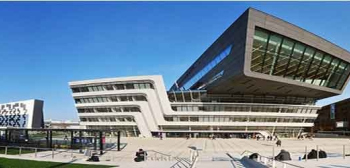
WU (Vienna University of Economics and Business)
Welthandelsplatz 1, 1020 Wien, Vienna
Featured University

Sponsored
446
QS World University Rankings
-
10 UG & 47 PGTotal courses
-
Private for ProfitStatus
-
HighResearch output
Shibaura Institute of Technology
basic
Private
Very High
21
no
843
M
EN